OPAIRS implementation phases for the smart enterprise
From focused system start to custom air-gapped architecture: define the right implementation scope for data integration, AI functionality and governance.
Scope overview
| Merkmal | Phase 1: System setup & productive start | Phase 2: BI & knowledge development | Phase 3: Smart Enterprise System |
|---|---|---|---|
| Use case & target group | |||
| Zielgruppe | KMU / Teams | Mittelstand & Enterprise | Konzerne & Spezialanforderungen |
| usersanzahl | <= 10 users | 10 - 30 users | >= 30 users |
| Typische Use Cases | 1–2 prioritized use cases | Mehrere Use Cases / Abteilungen | Complex domains, OT/edge, specialized processes |
| Time-to-Value | Fast (days) | Geplant (wenige Wochen) | Project-dependent (complexity-driven) |
| Skalierbarkeit | Begrenzt | Hoch | Unbegrenzt |
| Roadmap & Skalierungsplan | |||
| Deployment & operations | |||
| On-premise operation | |||
| Air-gapped / offline operation possible | |||
| Docker-Container Deployment | |||
| Optional Kubernetes / Multi-Node | |||
| Definierter Offline-Update-Prozess | |||
| Backup/Restore Konzept (Runbook) | |||
| Monitoring/Health-Checks | |||
| High availability (HA) / redundancy design | |||
| Hardware & scaling | |||
| All-in-one Box (HW+SW vorkonfiguriert) | |||
| Workstation → Server skalierbar | |||
| Multi-GPU / Hochlast-Inferenz | |||
| Capacity planning (CPU/RAM/GPU/storage) | |||
| Data sources & integration | |||
| Dokumente (z.B. PDF/DOCX/TXT) indexieren | |||
| Datenbanken (Basis-Connectoren) | |||
| Erweiterte Konnektoren (z. B. ERP/CMMS/MES) | |||
| SharePoint / Collaboration-Systeme | |||
| OT/Edge Datenintegration (Sensorik/Gateways) | |||
| Datenharmonisierung / Mapping (leicht) | |||
| Data harmonization (complex, multiple domains) | |||
| Data lifecycle: retention and deletion concept | |||
| Document processing & RAG | |||
| Standard RAG (Chunking + Embeddings + Vektorstore) | |||
| Hybrid Search / Reranking | |||
| Quellenanzeige / Zitate in Antworten | |||
| Strukturierte Extraktion (Tabellen/Forms) | |||
| Quality metrics (recall/precision) for RAG | |||
| OPAIRS assistant | |||
| Standard OPAIRS (with database access) | |||
| Special OPAIRS (with domain knowledge and integration) | |||
| Agentic OPAIRS (with tool access) | |||
| Automatic OPAIRS (with automation) | |||
| AI models & inference | |||
| Verifiziertes Basismodell-Set | |||
| Model Registry / Versionierung / Freigabeprozess | |||
| Model Routing (multiple models by task) | |||
| Fine-tuning / LoRA (if needed) | |||
| Guardrail OPAIRS (Policies, Tooling, Output Checks) | |||
| Workflows & automation | |||
| Standard-Workflows (Ingest, Re-Index, Q&A) | |||
| Approval-Flows (Human-in-the-loop) | |||
| Integrationen in ITSM/CMMS/Ticketing | |||
| Custom Agents/Tools | |||
| Robotik/Automatisierung (projektspezifisch) | |||
| Security baseline | |||
| TLS / Reverse Proxy / Netzwerksegmentierung | |||
| RBAC (Rollen & Rechte) | |||
| Secrets Management (kein Klartext) | |||
| Hardening (Server + Container) | |||
| Zentrales Logging (System + App) | |||
| Audit-Log (Abfragen, Admin-Aktionen) | |||
| Prompt-Injection Schutz (Basis) | |||
| Regular security tests (injection/policies) | |||
| Governance & compliance | |||
| Integration of Apache Ranger & Apache Atlas (in development) | |||
| EU AI Act Readiness (Transparenz & Oversight) | |||
| ISO 27001-ready Dokumentationspaket | |||
| ISO 27701-ready (PII-Flows, deletion concept) | |||
| NIS2-ready (Logging, Incident-Prozess) | |||
| Traceability (Quellen, Logs, Exporte) | |||
| Support & Lieferung | |||
| Standard-Dokumentation (Install/Runbook) | |||
| Erweiterte Doku (Security/Audit Packs) | |||
| Schulung Admins/Power-User | |||
| SLA / Wartungsfenster / Incident-Prozess | |||
| Projektbetrieb / Long-term Enablement | |||
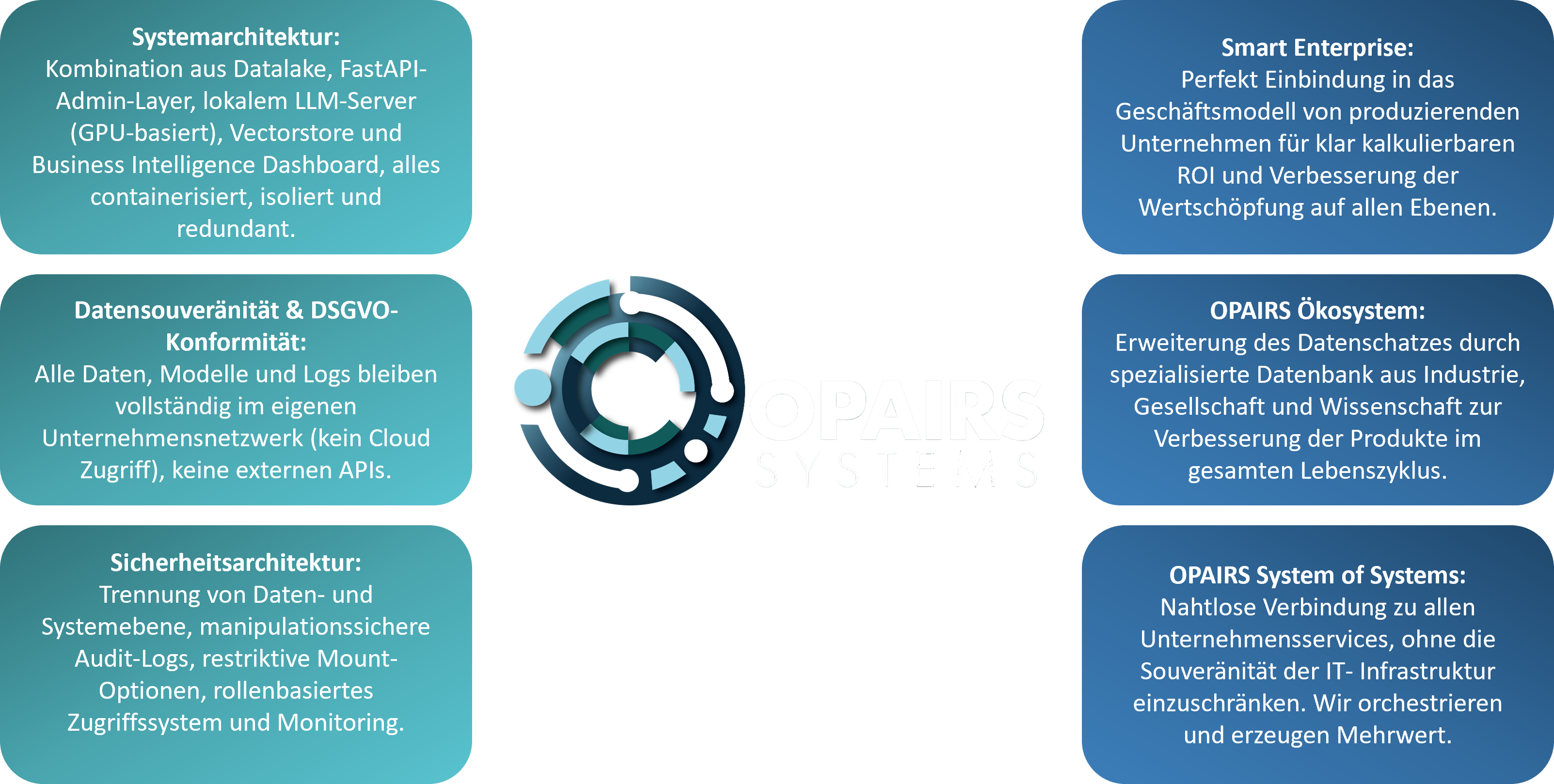
Phase 1: System setup & productive start
Build a sovereign AI and data foundation in your own infrastructure.
Phase 2: BI & digital twin
Systematic expansion of analytics, knowledge and decision capability.
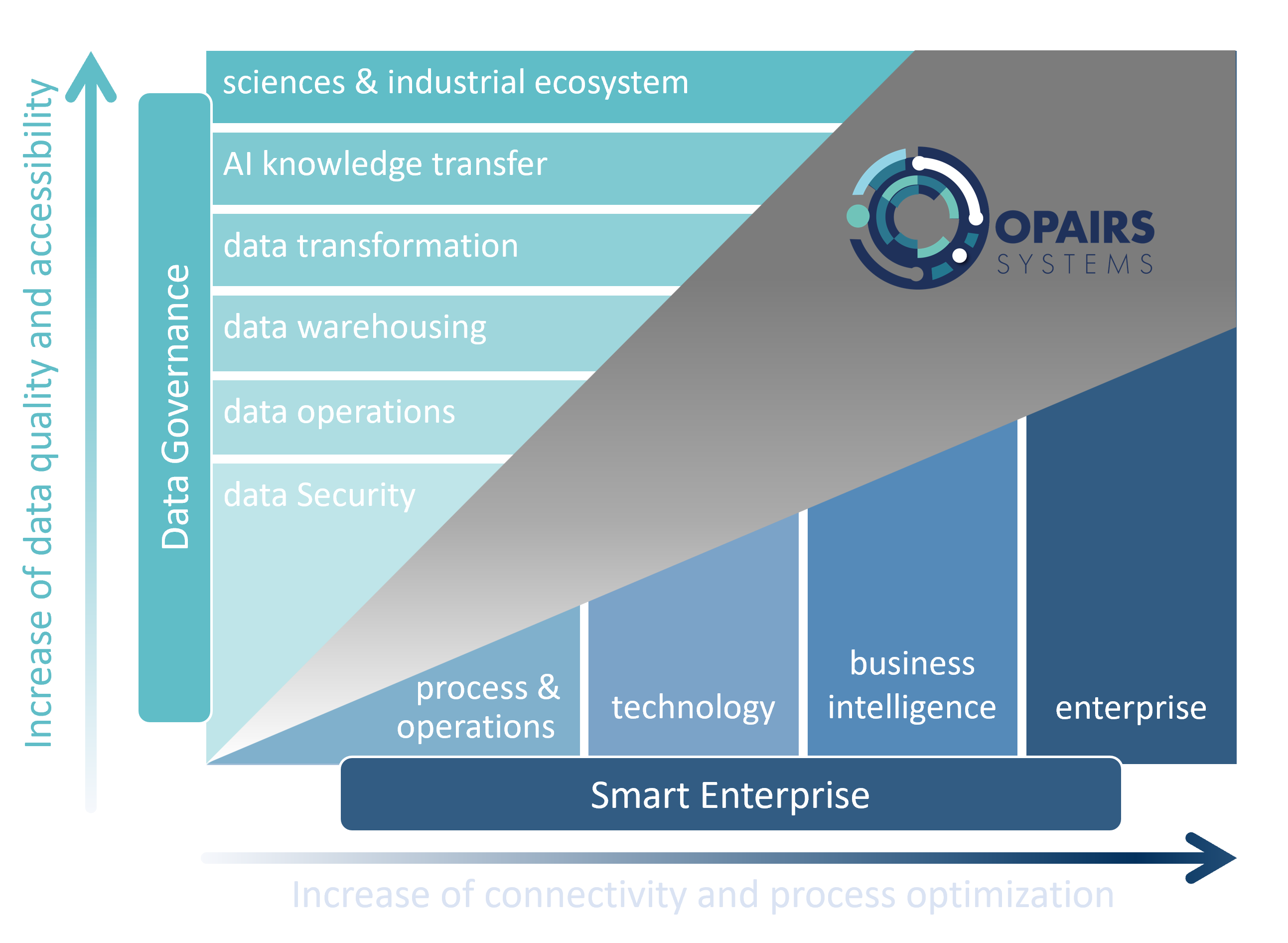
Phase 3: Smart Enterprise System
Custom system architecture in the OPAIRS ecosystem aligned with strategy and company culture.